
Signs Your Sarasota Driveway Needs Repair or Replacement
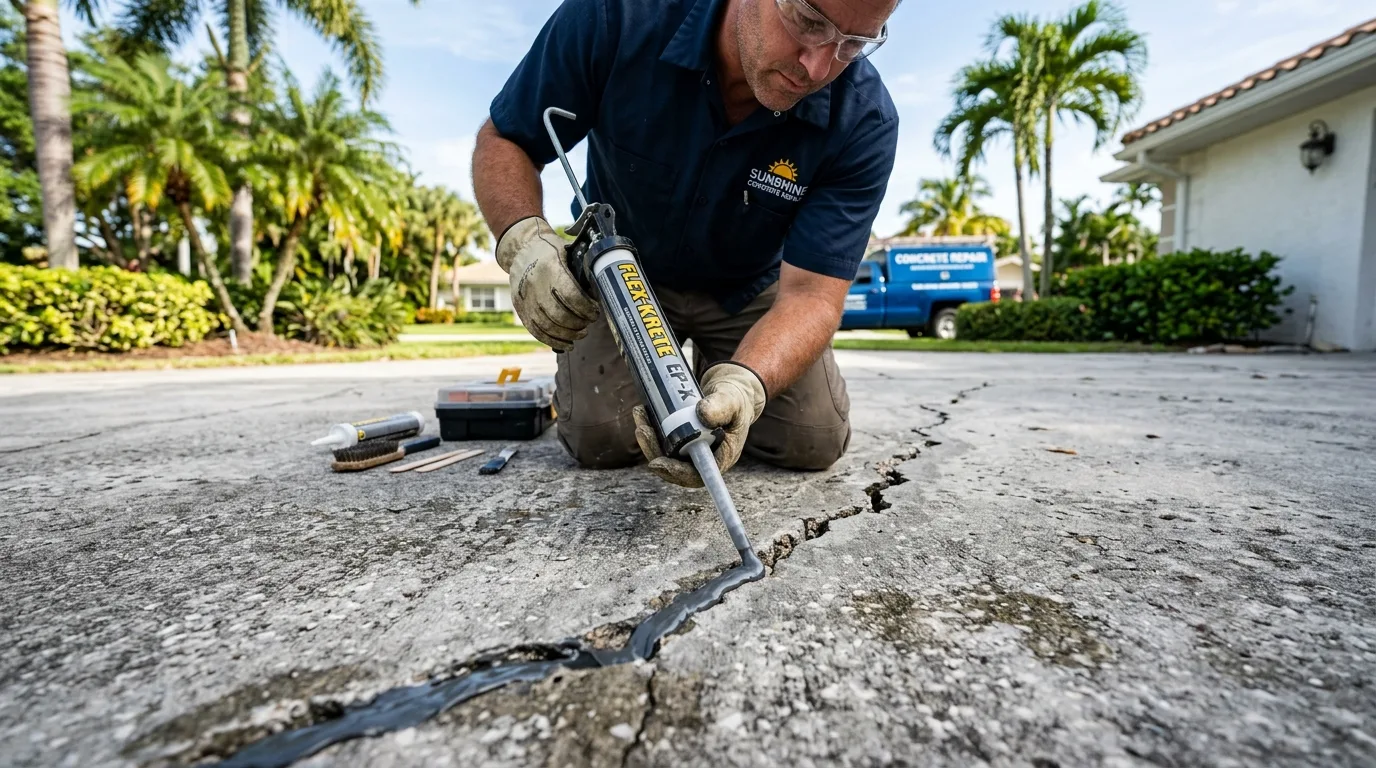
Most Sarasota homeowners wait too long. A driveway crack that would cost $200 to seal at year 5 becomes a settlement problem that costs $2,000 to stabilize at year 8, and a full replacement job at year 12 when water has undermined the sub-base. Knowing which warning signs require immediate attention — and which you can monitor — saves real money and prevents the situation where repair is no longer a viable option. In this post, we cover 9 specific warning signs for Sarasota driveways, what each sign actually means about the underlying condition, and the decision framework for repair vs. replacement.
Not Sure If Your Sarasota Driveway Needs Repair or Replacement?
We give you an honest assessment — repair vs. replace, with written reasoning and pricing options.
Why Warning Signs Progress Faster in Sarasota
The warning signs on a Sarasota driveway progress faster than in most markets because of the environment’s compounding factors. Sarasota County’s Myakka fine sand soil loses bearing capacity when saturated — and Sarasota’s June-through-September wet season saturates it reliably every year. Each wet season, any crack or drainage problem allows water under the slab, softening the sub-base further. By the time the driveway shows visible problems, the process has usually been underway for 2–3 years.
Understanding whether you’re seeing early-stage or late-stage warning signs is the difference between a cost-effective repair and an inevitable replacement.
9 Warning Signs for Sarasota Driveways
1. Hairline cracks (less than 1/8 inch wide): Normal concrete curing behavior. Seal with polyurethane crack filler to prevent water penetration. Monitor quarterly — if they grow, reassess.
2. Cracks wider than 1/4 inch: A meaningful warning sign. Cracks this wide allow water to infiltrate the sub-base and accelerate deterioration. Fill promptly with flexible filler. If crack edges show differential height (one side higher than the other), this indicates sub-base movement — more serious.
3. Settlement differential (one side of crack is higher): Sub-base material has moved or been washed away. The slab is no longer supported uniformly. Options: mudjacking to fill the void and level the slab, or slab replacement. Don’t ignore — settlement continues as long as drainage allows water to undermine the sub-base.
4. Multiple cracks in a grid or map pattern: Suggests the concrete was poured with inadequate control joints or in high-humidity conditions that caused plastic shrinkage cracking. If the pattern is stable and cracks are hairline, sealing and monitoring is appropriate. If cracks are widening or multiple sections have moved, replacement becomes cost-effective.
5. Surface spalling: Concrete flaking away from the surface, exposing aggregate or showing pitting. Common in Sarasota on driveways 15+ years old that were never sealed. Early-stage spalling (under 10% of surface area) can be addressed with polymer-modified mortar patch and resurfacing. Advanced spalling (25%+ of surface area) suggests the concrete has carbonated and surface repair is a temporary solution.
6. Pooling water: Water that sits on the driveway after rain rather than draining toward the street indicates drainage slope has changed — likely from settlement — or was never adequate. Water that pools near the garage and foundation is a serious drainage problem that needs correction in the next repair cycle.
7. Edge crumbling: The perimeter of the driveway is crumbling or flaking away. Common in Sarasota driveways without a properly formed and cured edge. Edge repair with mortar patch is an option for limited areas; if the crumbling extends along more than 30% of the perimeter, it typically indicates broader concrete quality issues.
8. Rocking or hollow sound: If a section of driveway moves under vehicle weight or sounds hollow when tapped, a void has developed beneath the slab — either from sub-base settlement or organic material (tree roots) that has decomposed. Mudjacking can fill voids and stabilize sections; replacement is necessary if the void is extensive.
9. Age 25+ years with multiple issues: A driveway past 25 years that shows more than two of the above symptoms is typically past the point where selective repairs are cost-effective. Multiple repairs address symptoms without fixing the underlying condition of an aged slab on a settled sub-base.
Practical Uses: Repair vs. Replace Decision Framework
- Single isolated crack, no differential height, no sub-base movement: Seal and monitor — repair.
- Multiple cracks with hairline width, stable, no drainage problems: Seal all cracks, consider resurfacing for appearance — repair.
- Settlement differential at one or two sections, rest of slab sound: Mudjacking the settled sections if void can be filled — repair with stabilization.
- 25%+ of surface area showing spalling, multiple sections settled: Replacement is more cost-effective than repair — the concrete is at end of life.
- Drainage consistently flowing toward foundation: Address immediately regardless of crack status — the drainage problem is more urgent than surface condition.
- Driveway over 25 years in established Sarasota neighborhood, tree roots visible: Inspect for sub-base compromise before investing in repair — root removal and sub-base reset may mean replacement is warranted.
Sarasota-Specific Accelerants: What Makes Driveways Fail Faster Here
Tree root intrusion is the most common cause of driveway failure specific to established Sarasota neighborhoods like Arlington Park, Rosemary District, and Downtown Sarasota. Mature oaks and palms — common throughout residential Sarasota County — send surface roots under concrete slabs over decades, lifting and cracking sections from below. This damage pattern is distinct from settlement cracking and requires root management as part of any repair or replacement plan.
Salt air near Siesta Key and Longboat Key accelerates carbonation of the concrete surface, making it more susceptible to spalling within 15–20 years for driveways that were never sealed. Regular sealing (every 2–3 years) dramatically slows this process.
Sarasota Driveway Assessment — Free, Honest, Written
Call Sarasota Concrete Company for a free assessment. We tell you what's actually needed — repair, stabilization, or replacement.
Frequently Asked Questions
How do I know if my Sarasota driveway needs repair or replacement?
The key indicators favoring replacement: multiple sections with differential settlement, surface spalling covering more than 25% of the area, cracks that extend through the full depth of the slab, drainage failure that’s redirecting water toward the foundation, and age over 25 years with multiple concurrent issues. Single-issue driveways — one problematic section, isolated cracking, surface-only spalling — are usually good candidates for targeted repair.
How long does a concrete driveway last in Sarasota, FL?
A properly installed concrete driveway in Sarasota typically lasts 25–35 years with regular sealing every 2–3 years. Poor sub-base preparation — common in driveways installed before today’s compaction standards — can reduce that to 10–15 years. Driveways in established Sarasota neighborhoods near mature trees may need earlier replacement due to root intrusion.
Can I repair a Sarasota driveway that has tree root damage?
Tree root damage requires addressing the root issue as part of the repair — simply patching the concrete without removing or managing the roots creates a repair that fails again within a few years. Root cutting, stump treatment, and base reset are necessary before a lasting repair or replacement. We assess root involvement during every driveway estimate in Sarasota’s established neighborhoods.
Sarasota Concrete Company — Repair or Replace? We'll Tell You.
Call (888) 376-0955 for a free, honest assessment of your Sarasota driveway condition.
Related: