
Stamped Concrete vs. Pavers: Which Is Better for Sarasota Homes?
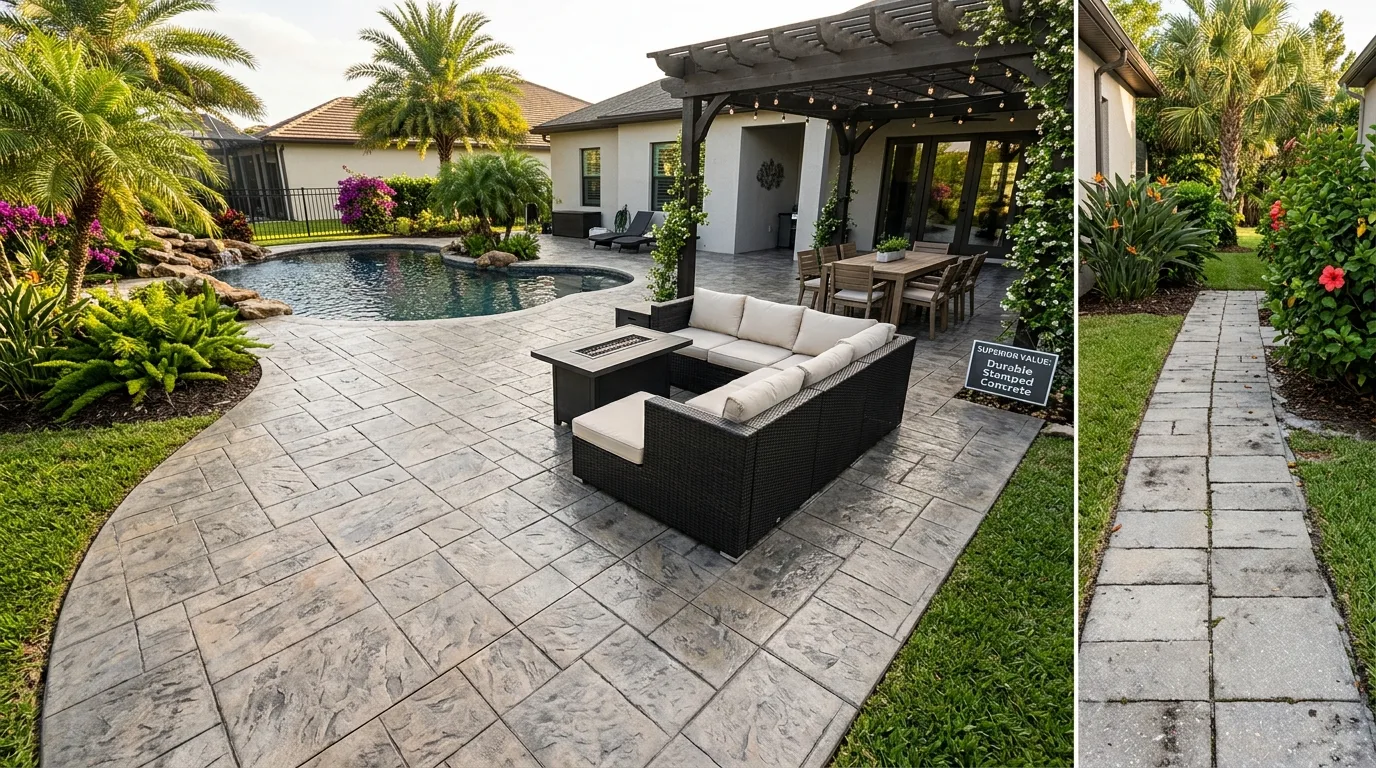
Pavers dominate the aesthetic conversation in Sarasota — drive through Lakewood Ranch or Palmer Ranch and you’ll see them everywhere. But does that mean they’re the right choice for your project? This post covers the stamped concrete vs. pavers debate specifically for Sarasota homeowners: cost, maintenance burden, lifespan under Southwest Florida’s conditions, and how HOA requirements shape the decision in master-planned communities throughout Sarasota County.
Stamped Concrete or Pavers for Your Sarasota Project?
We help Sarasota homeowners make the right call based on their site, HOA, and budget.
Why the Sarasota Market Makes This Comparison Worth Taking Seriously
In most of the country, stamped concrete and pavers are roughly equivalent quality choices with aesthetic differences. In Sarasota, FL, the comparison gets more nuanced because of three factors: the high humidity that affects both materials differently, salt-air exposure on barrier island properties, and the HOA architectural requirements that govern finish options in much of Sarasota County.
Stamped concrete is a monolithic poured slab with an impressed decorative pattern; pavers are individual interlocking units set in sand or mortar over a prepared base. Both are widely used in Sarasota for driveways, patios, and pool decks — but they have meaningfully different cost structures, maintenance demands, and performance profiles in this climate.
Types / Options
Stamped concrete (Sarasota cost: $13–$17/sqft): One continuous pour with no joints except the control cuts you design in. The pattern replicates stone, slate, brick, or wood. One contractor, one material, one warranty.
Concrete pavers ($15–$25/sqft installed): Individual precast units set in a sand or mortar bed. Many joint lines. High aesthetic versatility. Can be replaced individually if damaged — the selling point most paver contractors lead with.
Travertine and natural stone pavers ($20–$40/sqft): Natural materials, premium cost. Beautiful but porous and more demanding in Sarasota’s salt-air and high-humidity environment. Requires sealing and ongoing maintenance similar to stamped concrete but often at higher material cost.
Concrete overlay on existing slab ($8–$15/sqft): For homeowners with a sound existing concrete slab who want a decorative finish without demolition. Adds the stamped look without full replacement cost.
Practical Uses: When Each Option Makes Sense in Sarasota
- Stamped concrete for HOA driveways: Many Lakewood Ranch and Palmer Ranch ARBs accept stamped concrete when the color palette matches community standards. We provide material specs for ARB submission — pavers don’t always have an advantage here.
- Pavers for complex custom shapes: Curved driveways with irregular geometry are easier to execute in pavers, which can be cut to fit any radius without formwork complexity.
- Stamped concrete for pool decks in Sarasota: A continuous surface is easier to keep clean around pools than the 30+ linear feet of joints in a paver deck, which trap algae and require pressure washing more frequently in Sarasota’s year-round pool use climate.
- Pavers for future utility access: If you have shallow irrigation, gas, or electrical lines under the surface, pavers allow access without demolition — a real advantage in established Sarasota neighborhoods with aging infrastructure.
- Stamped concrete for coastal properties: Siesta Key and Longboat Key properties benefit from stamped concrete’s lack of joint gaps, which reduce sand infiltration and simplify maintenance in beach-adjacent environments.
- Pavers for phased projects: If you’re expanding the patio in phases, pavers let you match the original material more easily than trying to match a stamped concrete pour done 3 years earlier.
How Sarasota’s Climate Shapes the Performance Comparison
Sarasota’s humid subtropical climate creates specific conditions that affect both materials. Paver joints in Sarasota tend to accumulate organic growth — algae, moss, and ants find the joint sand hospitable in the warm, wet months. This requires periodic joint sand replenishment and pressure washing that stamped concrete — with far fewer joint lines — doesn’t demand at the same frequency.
Salt air on barrier island properties like Siesta Key affects both materials: it accelerates sealer degradation on stamped concrete and can cause efflorescence staining in paver joints. Neither material is clearly superior in coastal exposure, but maintenance schedules differ. Stamped concrete needs resealing every 2–3 years; pavers need joint sand replenishment and resealing every 3–5 years depending on exposure and traffic.
Comparing Stamped Concrete and Pavers in Sarasota?
Call Sarasota Concrete Company for a free consultation and estimate — we'll tell you what makes sense for your specific property.
Cost Factors: Sarasota-Specific Numbers
In Sarasota County, stamped concrete typically comes in less expensive than comparable paver work at the same project size. Stamped concrete driveways run $13–$17 per square foot; comparable paver work from qualified installers runs $15–$25 per square foot. The gap widens on larger projects where the continuous pour is more efficient than individual unit setting.
Long-term costs matter too. Stamped concrete’s main cost is resealing ($1–$3 per square foot every 2–3 years). Pavers require joint sand maintenance, occasional relaying where settlement occurs, and resealing. Over a 10-year period on a 500-square-foot surface, the total cost of ownership is generally comparable — but stamped concrete front-loads cost (higher installation, occasional resealing) while pavers distribute costs more across annual maintenance.
Frequently Asked Questions
Which is better for HOA communities in Sarasota — stamped concrete or pavers?
Both materials are approved in most Sarasota County HOAs including Lakewood Ranch and Palmer Ranch, though approval depends on your ARB’s specific standards for color, pattern, and finish. Pavers have historically been more popular in these communities, but stamped concrete with the right color selections is also frequently approved. We provide complete material documentation for ARB submissions for both materials.
Does stamped concrete hold up to Sarasota’s humidity better than pavers?
Stamped concrete is more sensitive to Sarasota’s high humidity during installation — the stamping window is compressed in summer humidity, requiring experienced crews. Once installed and sealed, both materials perform comparably in terms of structural integrity. The maintenance difference is that stamped concrete’s continuous surface is easier to clean in Sarasota’s algae-prone summer climate.
Can I replace a damaged section of stamped concrete in Sarasota?
Individual section replacement on stamped concrete is difficult — matching color and pattern after years of UV weathering is challenging. This is the genuine advantage of pavers: individual unit replacement is practical. For stamped concrete, full-surface resealing refreshes the color and conceals minor surface wear, making targeted replacement less necessary than with cracked or stained pavers.
Get a Free Stamped Concrete Estimate for Your Sarasota Property
We serve all of Sarasota County — from downtown to barrier islands to master-planned communities.
Related: