
Sarasota Concrete Foundations: What Homeowners Should Know
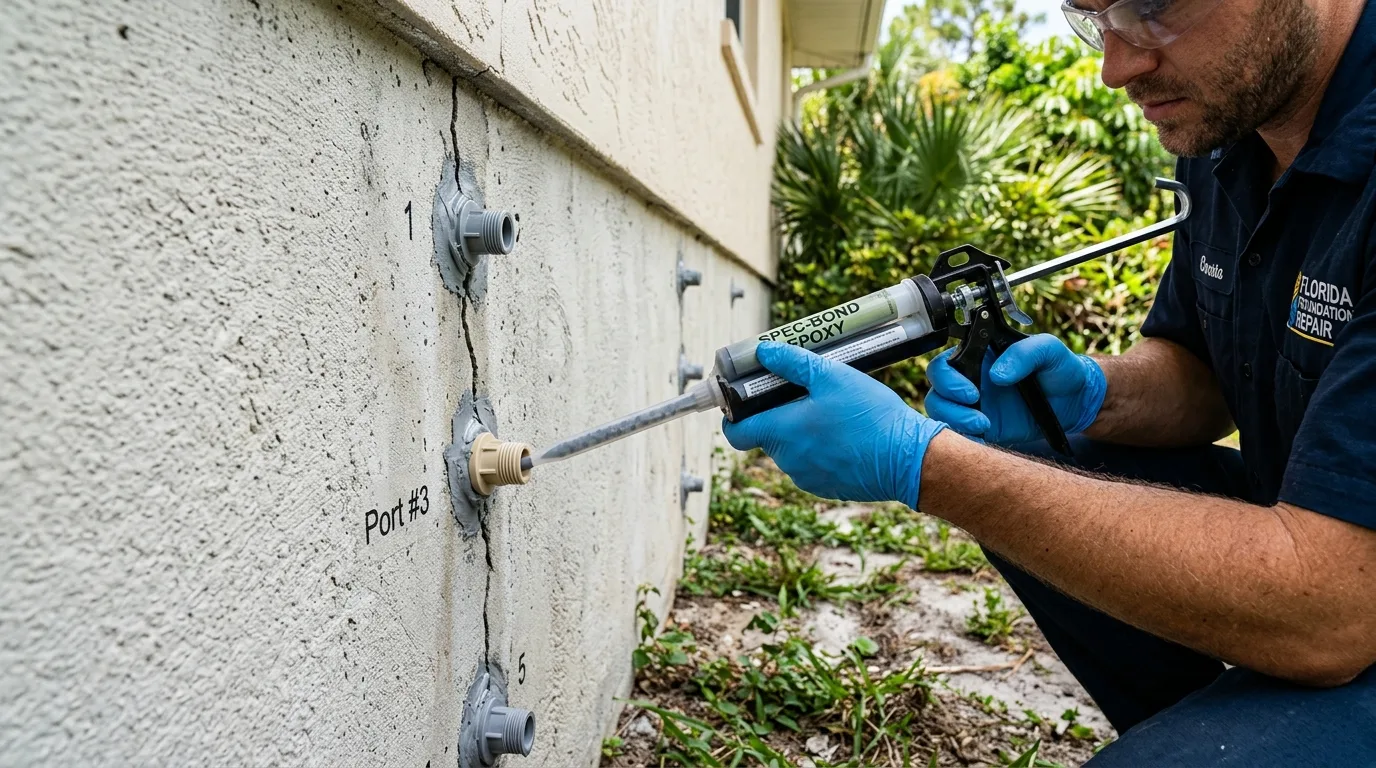
Most Sarasota homeowners don’t think about their concrete foundation until something goes wrong — a door that won’t close, a crack running diagonally from a window corner, or tile grout cracking in a pattern that suggests the floor has moved. By that point, the question has changed from “what kind of foundation should I get” to “how do I fix this one.” In this post, we help Sarasota homeowners understand concrete foundation types used in Sarasota County, why post-tensioned slabs have become standard here, what flood zone requirements mean for coastal properties, and when to call a concrete specialist vs. a structural engineer.
Concrete Foundation Questions in Sarasota?
We work with engineers and permit offices on foundation projects throughout Sarasota County — contact us for a free estimate.
Foundation Types Used in Sarasota County
Florida is a slab state. Unlike northern climates where foundations extend below the frost line (4–6 feet in some states), Sarasota County homes sit on slab-on-grade foundations — concrete slabs that sit directly on the prepared sub-grade at or near ground level. There is no basement, no crawlspace — the concrete slab is both the foundation and the finished floor substrate.
Two main slab systems are used in Sarasota:
Conventional rebar slab: Steel reinforcing bars placed in a grid pattern before the concrete pour. The rebar resists tension when the slab flexes under load. Common in Sarasota construction through the 1990s; still used on sites with stable, well-drained sandy sub-base conditions.
Post-tensioned slab: High-strength steel cables (tendons) placed in the slab before pouring. After the concrete cures, the cables are tensioned using hydraulic jacks — this places the entire slab under compression. Compression counteracts the tension stresses caused by soil movement. Post-tensioned slabs are significantly more resistant to differential settlement cracking than conventional rebar slabs and have become increasingly standard in new Sarasota County construction.
Why Post-Tensioning Matters in Sarasota County
The reason post-tensioning has become standard in much of Sarasota County is soil. While Myakka fine sand — the predominant soil under most of Sarasota — behaves reasonably well with proper compaction on flat, well-drained sites, parts of Sarasota County have expansive clay beneath the sandy layer. These clays shrink in Sarasota’s dry season and swell in the wet season, generating upward and downward soil movement that translates directly to slab stress.
Conventional rebar slabs on expansive clay soils crack — this is predictable and documented. The rebar resists tension but doesn’t prevent the differential movement that comes from one section of the slab being lifted by swelling clay while an adjacent section is not. Post-tensioning keeps the entire slab in compression, which is far more resistant to this type of movement. In Sarasota County’s developing areas like North Port and Wellen Park — where soil variability is significant — structural engineers regularly specify post-tensioned systems for new residential construction.
Flood Zone Requirements for Sarasota Foundations
Sarasota County’s coastal geography places a significant number of properties in FEMA-designated Special Flood Hazard Areas (SFHAs). Properties on barrier islands like Siesta Key and Longboat Key, in low-lying coastal neighborhoods, and near drainage features often carry AE, VE, or other flood zone designations that affect foundation design.
The primary flood zone impact on foundations:
Base Flood Elevation (BFE): Foundations in flood zones must have the lowest floor at or above the BFE shown on the FEMA Flood Insurance Rate Map for that location. This may require fill placement, elevated slab construction, or pier foundations to achieve the required elevation.
Flood-resistant construction: Materials below the BFE must be flood-resistant as defined by FEMA. Concrete and masonry are classified as flood-resistant; wood framing is not.
Flood openings: Enclosed areas below the BFE (garages, crawlspaces) require flood vents to allow water to equalize during flood events, preventing pressure differential that can destroy foundations.
Elevation certificate: A licensed surveyor must certify the finished floor elevation for flood zone properties. This certificate is required for permitting and affects flood insurance rates.
Practical Uses: When to Involve a Structural Engineer vs. a Concrete Contractor
- New construction foundation: Always requires a licensed structural engineer’s stamped drawings in Sarasota County. The engineer specifies slab thickness, reinforcement type (rebar vs. post-tension), concrete PSI, and any soil treatment. Concrete contractors build to the engineer’s specifications — not the other way around.
- Foundation crack repair: Hairline cracks in interior tile grout or concrete surfaces are common and usually not structural. Diagonal cracks running from corners, stair-step cracks in block walls, or vertical cracks in foundation walls warrant a structural engineer evaluation before any repair work.
- Addition or ADU foundation: Requires engineered drawings and Sarasota County permits, especially if the addition connects to the existing foundation.
- Commercial slab: Always requires engineering. Load capacity, thickness, and joint design must be calculated for the specific use.
- Flood zone property: Any foundation work in a FEMA flood zone requires permit, elevation certificate, and compliance with the 2023 Florida Building Code flood provisions. A licensed surveyor must document elevations.
Foundation Project in Sarasota County? We Work With Engineers.
Every foundation job we take on is properly designed, permitted, and inspected. Free estimates — call (888) 376-0955.
How the 2023 Florida Building Code Affects Sarasota Foundations
The 8th Edition of the Florida Building Code governs all construction in Sarasota County as of 2023. For concrete foundations, this means:
- Minimum concrete compressive strength of 2,500 PSI for slabs-on-grade (most Sarasota contractors use 3,000–4,000 PSI as standard practice)
- Reinforcement requirements based on soil bearing capacity and structural loads
- Special seismic provisions (Sarasota is in Seismic Design Category A — low risk, but provisions still apply)
- High-velocity hurricane zone (HVHZ) requirements apply to coastal properties in parts of Sarasota County
Sarasota County building permits for foundations require plan review and multiple inspections — pre-pour inspection (confirming reinforcement and forming before concrete is placed) and typically a final inspection. Work that doesn’t pass inspection requires correction before the pour or additional concrete work at the contractor’s expense.
Frequently Asked Questions
What type of concrete foundation is best for Sarasota, FL?
For sites with stable sandy sub-base conditions, conventional rebar slab-on-grade foundations perform well in Sarasota. For sites with expansive clay soils — common in some parts of Sarasota County — post-tensioned slabs provide significantly better performance by keeping the slab in compression and resisting differential settlement. Structural engineers make this determination based on a soil report for your specific site.
How do I know if my Sarasota foundation is post-tensioned?
Post-tensioned slabs in Sarasota typically have small circular “pockets” visible at the perimeter — these are where the tendons were stressed and cut off after tensioning. The pockets are usually patched with mortar after stressing. If you have a home built after 2000 in Sarasota County, it’s likely post-tensioned — confirm with your original construction documentation or a structural engineer.
Do I need a permit for foundation work in Sarasota County?
Yes — all foundation work in Sarasota County requires a building permit and stamped engineering drawings. This applies to new construction, additions, and structural repair. Surface cracks in concrete or tile are not necessarily structural and may not require permits for repair, but any work affecting the slab structure does. Confirm with Sarasota County Building Services before starting any foundation work.
Sarasota Concrete Foundations — Built to Code
Call Sarasota Concrete Company at (888) 376-0955. We handle permitting, inspections, and engineering coordination.
Related: