
Sarasota's Sandy Soil and Your Concrete Driveway: What to Know
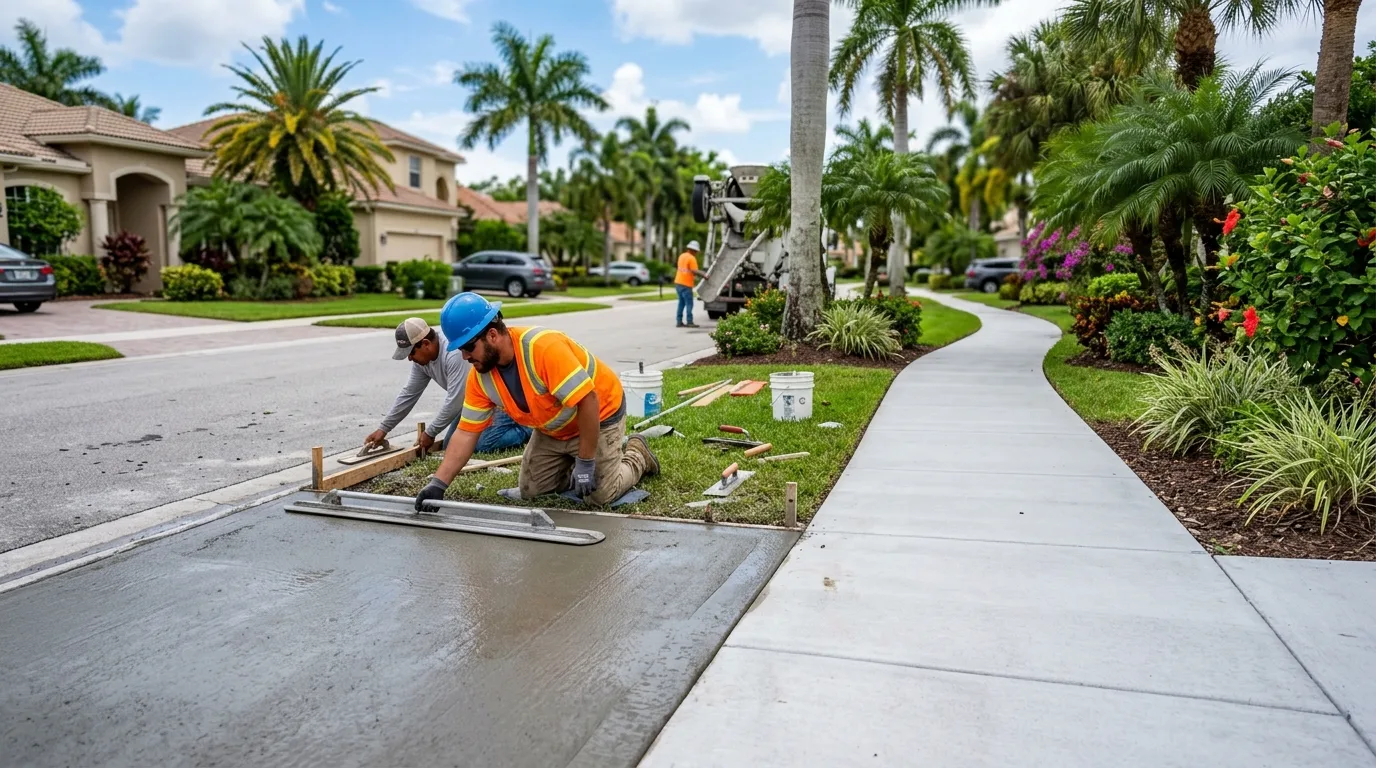
Sarasota homeowners who’ve replaced a 15-year-old driveway often hear the same explanation from the contractor: “Your sub-base wasn’t compacted properly.” What that means in practice — and why it matters specifically in Sarasota County — is something most homeowners never learn until they’re writing a second check for a driveway they thought would last 30 years. In this post, we cover what Sarasota’s Myakka fine sand soil actually does under concrete, why it’s the #1 cause of premature driveway failure in this area, and what proper sub-base preparation looks like on a Sarasota driveway project.
Sarasota Driveway Questions? We Know the Local Soil.
We assess sub-base conditions on every estimate — free, with no obligation.
What Makes Sarasota’s Soil Different
The Myakka fine sand is the official state soil of Florida, and it dominates the soil profile across most of Sarasota County — particularly in the flatwoods and former wetlands that make up a large portion of residential land in areas stretching from Palmer Ranch to North Port. It’s a loose, fine-grained sandy soil with low cohesion and limited inherent bearing capacity.
In dry conditions, Myakka sand compacts reasonably well when properly treated. The problem is what happens in Sarasota County’s wet season. When June–September brings 40–50 inches of concentrated rainfall, the water table rises, saturating the soil beneath your driveway slab. Saturated Myakka sand loses its bearing capacity — it essentially becomes a slurry under load. Vehicle weight causes the slab to flex downward into the softened base material, creating micro-cracks that allow more water in, which softens more base material, which allows more flexing. The cycle compounds rapidly.
Types / Options for Sub-Base Preparation
Compacted native soil (minimum acceptable): Simply grading and compacting the existing sandy soil. Meets code minimum in some applications but provides the least bearing support. Appropriate only for light-use applications on well-drained sites.
Imported crushed shell or limerock base: 4–6 inches of crushed shell or limerock compacted in lifts. Common in Sarasota County for residential driveways. Provides better drainage and more consistent bearing than native sand alone.
Soil stabilization (recommended on clay or expansive soil zones): Some parts of Sarasota County have expansive clay soils beneath the sandy layer. These clays shrink in dry season and swell in wet season — generating movement that standard base preparation doesn’t address. Lime or cement stabilization of the sub-base layer solves this for $2–$4 per square foot additional cost.
Post-tensioned slab system: For foundation slabs on expansive clay zones in Sarasota County, post-tensioned systems provide the most movement resistance. Less common for driveways than for foundations.
Practical Uses: What Proper Sub-Base Looks Like on a Sarasota Project
- Excavation depth: A properly built Sarasota driveway is excavated 10–14 inches from finished grade — 4 inches of concrete plus 4–6 inches of compacted base plus whatever fill is needed for drainage slope. Contractors who quote a “standard” driveway without asking about existing grade are likely underestimating.
- Compaction testing: On larger projects, a Proctor density test or nuclear gauge reading confirms compaction meets 95% Modified Proctor density — the standard for residential driveways in Sarasota County. Ask your contractor whether they use a compaction test or just a visual inspection.
- Moisture barrier: Some Sarasota driveway installations include a 6-mil poly vapor barrier between the base and the concrete pour to reduce moisture migration into the slab from the saturated base during wet season.
- Edge treatment: The perimeter of a Sarasota driveway is particularly vulnerable because it’s where base material is thinnest and most exposed to lateral moisture movement. Proper forming and curing at the edge prevents the edge spalling that’s common in poorly installed driveways.
- Expansion joints: Control joints cut or tooled every 8–10 feet create planned weak points where the slab will crack — directing cracking to the joint rather than randomly across the surface.
- Drainage slope: Sarasota’s flat terrain and heavy rainfall make drainage slope critical — minimum 1/8 to 1/4 inch per foot away from the structure, with positive drainage toward the street or a collection point.
How Wet Season Behavior Reveals Poor Sub-Base Prep
The telltale sign of inadequate sub-base preparation in Sarasota appears within 3–7 years: slab sections that have settled unevenly, creating visible depressions or lips at control joints. The settlement pattern typically shows where the soil saturation was worst — low spots, areas near downspouts, sections near the street where storm water backs up. In established Sarasota neighborhoods like Arlington Park and the Rosemary District, we regularly see 20-year-old driveways with this pattern — they lasted as long as they did because the concrete is thick, not because the sub-base was adequate.
Tree root intrusion is a related cause of driveway failure specific to Sarasota’s mature residential neighborhoods. Root systems from the oaks and palms common throughout Sarasota work their way under slabs over decades, lifting and cracking sections from below. Addressing root intrusion before a new driveway pour — cutting roots, treating stumps — prevents the replacement driveway from being damaged by the same issue.
Get a Sarasota Driveway Estimate That Accounts for Soil Conditions
Every estimate we provide assesses sub-base requirements specific to your site — no cookie-cutter specs.
Frequently Asked Questions
Does Sarasota County require a specific sub-base depth for concrete driveways?
Sarasota County’s building code specifies minimum concrete thickness and reinforcement for permitted driveways, but base depth is governed more by soil engineering than code specification. For Myakka fine sand, 4–6 inches of compacted limerock or crushed shell base is standard practice among experienced local contractors. Sites with expansive clay soils require soil stabilization regardless of what minimum code technically requires.
How do I know if my existing driveway failed because of sub-base problems?
The pattern of cracking and settlement tells the story. Random cracking across the slab surface suggests shrinkage or expansion joints spaced too far apart. Settlement cracks — where one side of a crack is lower than the other — indicate sub-base movement. If sections have settled unevenly, that’s almost always a sub-base preparation or drainage problem. A contractor can assess this during a free estimate.
Can I repair a driveway that failed due to Sarasota’s sandy soil?
Minor settlement (under 1/2 inch) can sometimes be addressed with mudjacking or polyurethane foam injection under the settled slab. Significant settlement, widespread cracking, or drainage failure usually means the driveway has reached the end of its useful life and warrants replacement with proper sub-base preparation. We give honest repair-vs-replace assessments at no charge.
Sarasota Concrete Company — Built for Local Soil Conditions
Call (888) 376-0955 for a free driveway estimate. We assess sub-base conditions as part of every proposal.
Related: